Gaze3P: Gaze-Based Prediction of User-Perceived Privacy
Authors: Mayar Elfares (University of Stuttgart, Germany), Pascal Reisert (University of Stuttgart, Germany), Ralf Küsters (University of Stuttgart, Germany), Andreas Bulling (University of Stuttgart, Germany)
Volume: 2026
Issue: 1
Pages: 6–25
DOI: https://doi.org/10.56553/popets-2026-0002
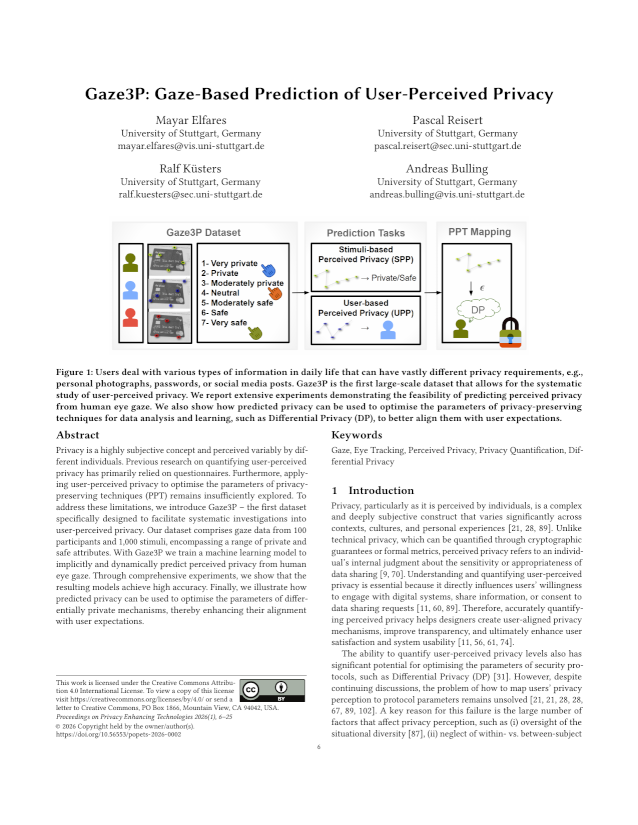
Abstract: Privacy is a highly subjective concept and perceived variably by different individuals. Previous research on quantifying user-perceived privacy has primarily relied on questionnaires. Furthermore, applying user-perceived privacy to optimise the parameters of privacy-preserving techniques (PPT) remains insufficiently explored. To address these limitations, we introduce Gaze3P-- the first dataset specifically designed to facilitate systematic investigations into user-perceived privacy. Our dataset comprises gaze data from 100 participants and 1,000 stimuli, encompassing a range of private and safe attributes. With Gaze3P we train a machine learning model to implicitly and dynamically predict perceived privacy from human eye gaze. Through comprehensive experiments, we show that the resulting models achieve high accuracy. Finally, we illustrate how predicted privacy can be used to optimise the parameters of differentially private mechanisms, thereby enhancing their alignment with user expectations.
Keywords: Gaze, Eye Tracking, Perceived Privacy, Privacy Quantification, Differential Privacy
Copyright in PoPETs articles are held by their authors. This article is published under a Creative Commons Attribution 4.0 license.